

01
What to preserve
Identify the needs that sustain current value and should not be weakened by new bets.
Before increasing investment, roadmap scope, or complexity, discover which needs truly justify resources.
Which evidence shows that the priorities receiving resources address relevant customer needs? We help leadership connect those needs to customer value, business value, and investment decisions.


Each area sees a legitimate part of reality. The problem begins when requests, opportunities, trends, and opinions start competing for resources as if they had the same strategic impact.
“Requests an improvement.”
“Sees an opportunity.”
“Defends the roadmap.”
“Must choose where to place the bet.”
The strategic question is not who is right. It is which needs justify changing the organization now.
The Need Gap 2026 brings together 1,423 needs that reached the quantitative stage in research conducted by 59 companies within their own customer bases.
The study reveals that the challenge is not finding needs, but distinguishing which ones are relevant enough to guide decisions capable of generating and capturing value.
Source: The Need Gap 2026. Analysis of 1,423 needs taken to quantitative validation across 59 companies. See the study for the research method.
The Institute does more than deliver data. It organizes evidence so leadership can distinguish what should be preserved, where there is room to expand value, and what should stay off the agenda.
Identify the needs that sustain current value and should not be weakened by new bets.
Recognize relevant needs that still create room for product, innovation, positioning, or expansion.
Prevent isolated requests and low-impact possibilities from becoming permanent complexity.

Starting with a decision your company needs to make, we investigate customer needs qualitatively, validate their relevance quantitatively, and use ICAN to support executive interpretation. The result connects relevant needs to customer value and the business implications of each priority.
The insight narrowed the hypothesis space and focused experimentation on a need with leverage potential.
The evidence led to a revision of positioning and commercial direction.
The company reduced dispersion and concentrated resources on priorities with stronger fit.

“Even perfect execution cannot correct a wrong priority.”
More than ten years ago, George founded CoBlue, a pioneer in OKRs in Latin America. Experience with hundreds of companies moved his work from execution to an earlier question: what truly deserves to be a priority? Today he develops Need-Based Decision Science and the ICAN metric.
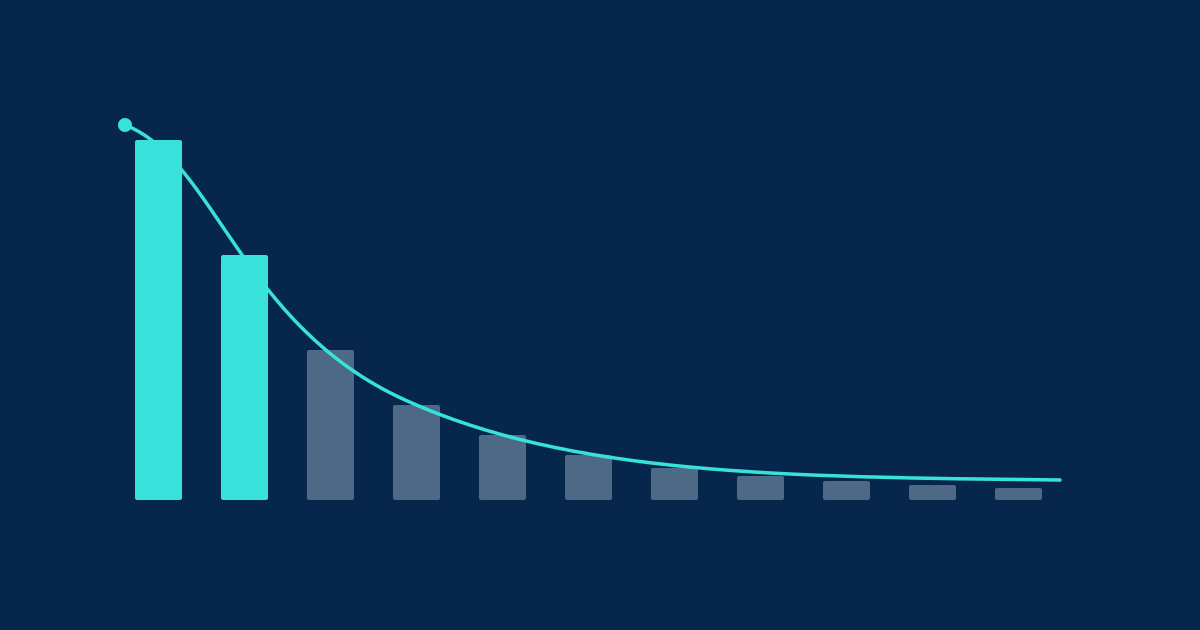
Approximately 8 in 10 analyzed needs — 80.32% — did not become a priority for even 30% of participants in their respective studies. The result applies to the studied sample.
It is company-specific research that combines qualitative investigation, quantitative validation, ICAN, and executive interpretation to inform a real resource-allocation decision. It is distinct from The Need Gap 2026, the public consolidated study.
No. The work connects research evidence to executive interpretation and implications for strategy, product, innovation, and positioning. Implementation and ongoing advisory work require a separate scope.
The Need Gap 2026 brings together evidence on relevance, concentration of priorities, and implications for strategy, product, and innovation.
Bring the decision, the alternatives under consideration, and your deadline. The Institute helps identify which evidence is missing before resources are committed.
Help me define our priorities